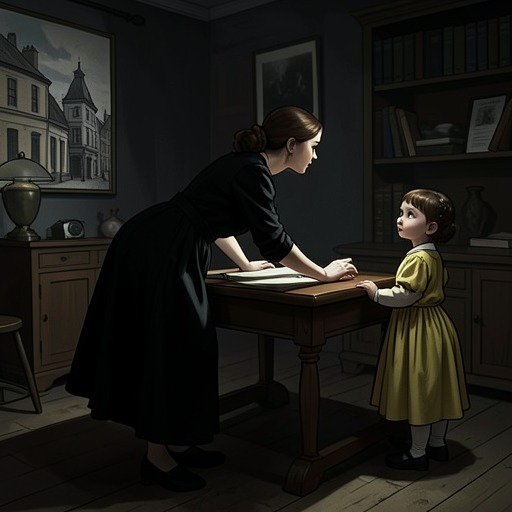
Louise Laboine leaves home for Paris
Maigret and the Dead GirlLouise Laboine leaves home for Paris at sixteen, turning a birthday departure into a lasting break with her mother, Germaine Laboine. The event is known not through a narrated scene of Louise going away but through a police interview years later: a letter marks her intention to leave for good, her mother makes no report, and a later message from Mademoiselle Poré connects the absent girl with Paris. That chain of fragments makes the departure both a decisive rupture in Louise’s life and an early clue in the investigation of what became of her.
Circumstances and the Letter
Four years before the interview, Louise left home and left behind a letter saying that she was going for good. The account supplies neither the wording of the whole letter nor an explanation of what prompted her to leave. Its significance lies in the finality it conveys: this was not described as a brief absence or an uncertain plan to return. The letter is the only stated communication Louise left at the moment of departure, and it stands in for the scene itself. The reader learns her intention through a written trace rather than through an account of her preparations, her journey, or any farewell between mother and daughter.
Louise left on her birthday, when she was just sixteen. That detail fixes her age and gives the separation a sharply identifiable date in the family’s history, but the account does not say that the birthday caused or motivated her decision. The coincidence instead makes the departure especially legible as a threshold: the day associated with her turning sixteen is also the day she left home. The event is therefore marked by a contrast between an occasion that might ordinarily gather family attention and the beginning of an absence that would endure.
The Break and Her Mother’s Response
Germaine Laboine had heard no word from Louise in the four years since she left. The account presents the silence as continuous: it identifies no later meeting, message from Louise, or reconciliation. In the investigation, that long absence is not an abstract family history. It helps establish how little direct information Germaine can provide about her daughter’s subsequent life, while making the few surviving communications unusually important.
Germaine did not inform the police when Louise disappeared. Asked about this, the investigator says he thought the mother had been rather glad to be rid of her. That is the investigator’s judgment, not an explanation of Germaine’s private motives or a statement that the text proves how she felt. Still, the detail complicates the departure: Louise’s disappearance did not lead her mother to seek official help, and the available account offers no sign that the separation was immediately treated as an emergency. The distinction matters. Louise’s letter declared an intention to leave, but the adult response described in the interview was not a police search; the estrangement continued without any reported contact from Louise.
Mademoiselle Poré’s Letter and Paris
A few months after the departure, Germaine received a letter from Mademoiselle Poré, who lived on Rue de Chemin Vert. Poré advised Germaine to keep an eye on Louise and warned that it would be as well not to leave her alone in Paris. This message is the account’s concrete link between Louise’s departure from home and her presence in Paris. It does not specify how Louise reached the city, where she was staying, or what had happened to her during the intervening months. Nor does it say whether Germaine acted on the warning. Its importance is narrower, but substantial: someone in Paris knew enough about Louise’s circumstances to contact her mother and urge attention to her welfare.
The address becomes a practical lead only years later. Germaine does not know the number of Poré’s house during the interview, but promises to provide it that evening. The information arrives with limits—there is a street and a correspondent, but not yet a usable house number—and those limits shape what the police can do next. The four-year-old departure thus enters the present investigation through an incomplete paper trail: Louise’s own farewell letter, followed months later by Poré’s warning, then Germaine’s belated offer of an address.
Retrospective Significance
The departure is disclosed retrospectively, as reported information in a police conversation rather than a dramatized episode. Its sequence is clear even though its circumstances are not: Louise left at sixteen on her birthday, her mother heard nothing afterward, and Poré’s letter arrived a few months later with a warning about Louise in Paris. The gaps are equally important. The account does not establish Louise’s reasons for leaving, the precise course of her journey, or what became of her after Poré wrote.
This restrained disclosure makes the departure consequential without pretending to solve it. The letter records Louise’s resolve; the mother’s silence and failure to report her disappearance establish the depth of the rupture; Poré’s message supplies a possible point of contact and an investigative lead. In the conversation, a four-year absence becomes a chain of particulars that can be followed, though not yet completed. The event’s significance lies both in the break itself and in the way those scattered traces allow the police to begin reconstructing Louise’s life beyond home.